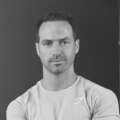
For most of the men who reach the top of competitive physique sport, the question of what to take is not really a question. It is an entry fee. The line between a clean athlete and a chemically optimised one runs not through the locker room but through the wallet of whoever is willing to spend more on a better protocol. Steve Cook is one of the few men in the sport’s recent history willing to name the price out loud.
“It became very apparent early on that you’re not going to be able to win these top-level shows,” Cook says. “It’s not an even level playing field, because there’s guys that are taking four or five compounds. And that’s inevitably when I decided to quit competing, because I felt like if I’m doing all of this stuff to be competitive, I then lose my identity as someone who preaches health.”
This is the centre of Cook’s reckoning. Not the moment he started taking things. The moment he stopped scaling them up.
Cook is now in his late thirties, retired from the Men’s Physique stage, and one of the longer-running figures in social-media fitness. The career began in natural bodybuilding, tested, polygraph and urinalysis, no ambiguity, and ended on the IFBB Olympia stage, where the ambiguity is the entire structure. What sits between those two points is a question most former competitors will not answer in their own name. Cook does.
What Steve Cook actually took: Winstrol, Anavar and pro hormones
The first answer is the surprising one. Not testosterone. “It was always a Winstrol or an Anavar to help me get lean and retain size,” he says. The path in had begun earlier, in college, with over-the-counter products sold in Utah gyms and supplement stores, marketed as legal alternatives to steroids. They were, Cook says, “just as nasty as steroids” in their side-effect profile. Gynecomastia. Suppressed natural testosterone. The compounds his generation came up on before the rules tightened.
Testosterone itself, the foundational compound of modern competitive bodybuilding, came late and small. “I never really took testosterone,” Cook says. “Testosterone in my head was like, I’m gonna get gigantic if I start taking that. So that really wasn’t part of my competing regimen.” His final competitive show was on a low, prescribed dose, addressing the suppressed natural production caused by the years of cutters that came before it.
The disclosure matters because it is specific. There is a difference between admitting in the abstract that you “took something” and naming the compounds and the reasons. Cook does the second thing.
What he says about the rest of the field is more pointed. “I think the base of every bodybuilder now is testosterone. Testosterone is where you start.” The cutting compounds, the growth factors, the substances that change a man’s facial structure visibly enough that Cook can recognise the use across a stage — those come on top.
“It is a pharmacy race too. It is who is responding to what.”
This is the line that does the work. The implication is unmistakable: at the top tier of physique sport, hard work is necessary but no longer sufficient. The variable that separates the winners from the also-rans is which compounds, in which combinations, the athlete’s body responds to best. Genetic outliers exist, Cook concedes — there are professional athletes whose muscle-to-fat ratios genuinely sit at the edge of what a clean athlete could build. But “for the most part,” at the level he competed at, he could spot the use as easily as a sommelier spots a corked bottle.
Why Steve Cook stopped competing
The decision Cook describes was not, in his telling, a moral one. It was a competing-priorities one.
He is, by his own description, an all-or-nothing person. The same trait that built the career — the discipline of years of competing, the obsessive process orientation he now applies to golf — would have applied to the next stack. “If I decided, hey, I’m gonna jump into this,” he says, “there’s no doubt in my mind that I would have been able to compete at the highest level and maybe won some shows. But I would have had to be on those three, four, sometimes even five compounds. Because you have your testosterone and then you have cutters and you have all of these different substances in your body.”
The barrier was not the use. He had already used. The barrier was scale.
What Cook recognised, and what he names clearly, is that the four-or-five-compound stack required to win at Olympia level conflicted with the identity he had built around himself. Not the body image — the public-facing role. He had spent years preaching health to an audience that trusted him in part because he looked like the version of fitness they could plausibly aspire to. Becoming someone who privately took five compounds to win shows while publicly preaching health was, Cook decided, a contradiction he could not stand inside.
So he stopped. Not the substances entirely, he was on prescribed TRT by then, a fact he does not hide, but the trajectory. The competitive scaling-up. The next show, the next compound, the next placing.
“There’s no doubt in my mind,” he says, “I would have been able to compete at the highest level.”
He is sure he could have. He is just as sure he did not want what winning would have required him to become.
The Olympia counterfactual
What gives the conversation its weight is that Cook does not pretend the decision is settled in his head. The Olympia daydream comes back.
“I often will think back, just in those moments of like, man, what could I have done if I had taken four or five different substances? Would I have won a couple Olympias? What would have that done for my life? Would I be in any different spot? Would I be a better person for it? Would I feel like I, looking myself in the mirror, would I feel any different?”
This is not regret in the conventional sense. It is the older man’s version of the question — the one that asks whether the trade was correctly made not at the moment of the decision but at the distance of a decade. Cook does not answer it. The question stays open.
What he does say, and what he is careful to say, is that the cost of the other fork has become harder to ignore. Bodybuilding has been losing young men in unusual numbers in the last two or three years. Cook is explicit that he is not a doctor and cannot draw causal conclusions; he flags only that he has noticed the pattern and that other people have noticed it too. The question of what years on four-or-five-compound stacks does to the cardiovascular system, to the kidneys, to whatever else, is not something he is positioned to answer. But he is positioned to say that he has watched men he competed alongside die, and that the conversation about why is one the sport is not having clearly.
For Cook, the personal calculation is simpler than the medical one. “I couldn’t be healthy.”
That is what the decision came down to, in the end. Not whether five compounds would have produced a better physique. Not whether they would have produced a better placing. Whether the man taking them could continue to call himself healthy in the way he meant the word.
He decided he could not.
Steve Cook on the Liver King and the natural-or-not question
The other thing that distinguishes Cook from most of the influencer field is that he has a stated position on disclosure, and the position is unusual.
He does not believe everyone who uses should disclose. The standard he holds is narrower than that.
“I’m not going to ever judge them,” he says of bodybuilders on steroids, “unless they’re out there preaching that they’re natural.” That is the line. The Liver King’s offence, in Cook’s framing, was not the use — it was the loud, sustained, monetised insistence on the absence of use. The lie about the source of the physique. The grift built on the lie.
Cook applies the same standard to himself. He describes himself as “natural right now”, and then qualifies the claim in the same answer: “And what I say is right now, I’ve taken TRT in my life. I’ve taken substances I wouldn’t claim as natural.” The TRT is current; the previous compounds are not; the word “natural” is doing very specific work in that sentence. He is, he is telling you, optimised but not loaded. Healthy by his own definition but not in the technical sense the supplement-store version of the word implies.
What this position avoids is the harder claim, that an industry which makes its livelihood from physiques that are increasingly impossible to build naturally has a moral obligation to mark the line clearly for its audience. Cook does not make that argument. He gestures at it occasionally, the comparison to women removing breast implants, the observation that 90% of steroid users he has read about are recreational rather than competitive, the worry about young men taking compounds for an Ibiza holiday rather than a show but he stops short of the position that would compel disclosure across the field.
What he tells the young men who DM him asking about taking steroids is, characteristically, both more cautious and more practical than a moral position. “Have you maxed out your potential naturally? If you have, keep going with that. If you’re a young person, keep going with that.” The second answer, for the ones whose biggest aspiration in life is to be Mr. Olympia, is that the fork in the road is not a fork they can postpone forever. At some point the choice becomes binary: scale up or change your goal.
That is the choice Cook himself made. He changed the goal.
What he refuses to say, and the refusal is part of the position, is that everyone who took the other fork made the wrong choice. The pharmacy race continues. The young men keep messaging. The Olympia stage will be won this year by someone on a stack Cook could have matched.
He is not telling them they were wrong.
He is telling them what it cost him to find out he could not.
Photograph Dmitrii Shirnin